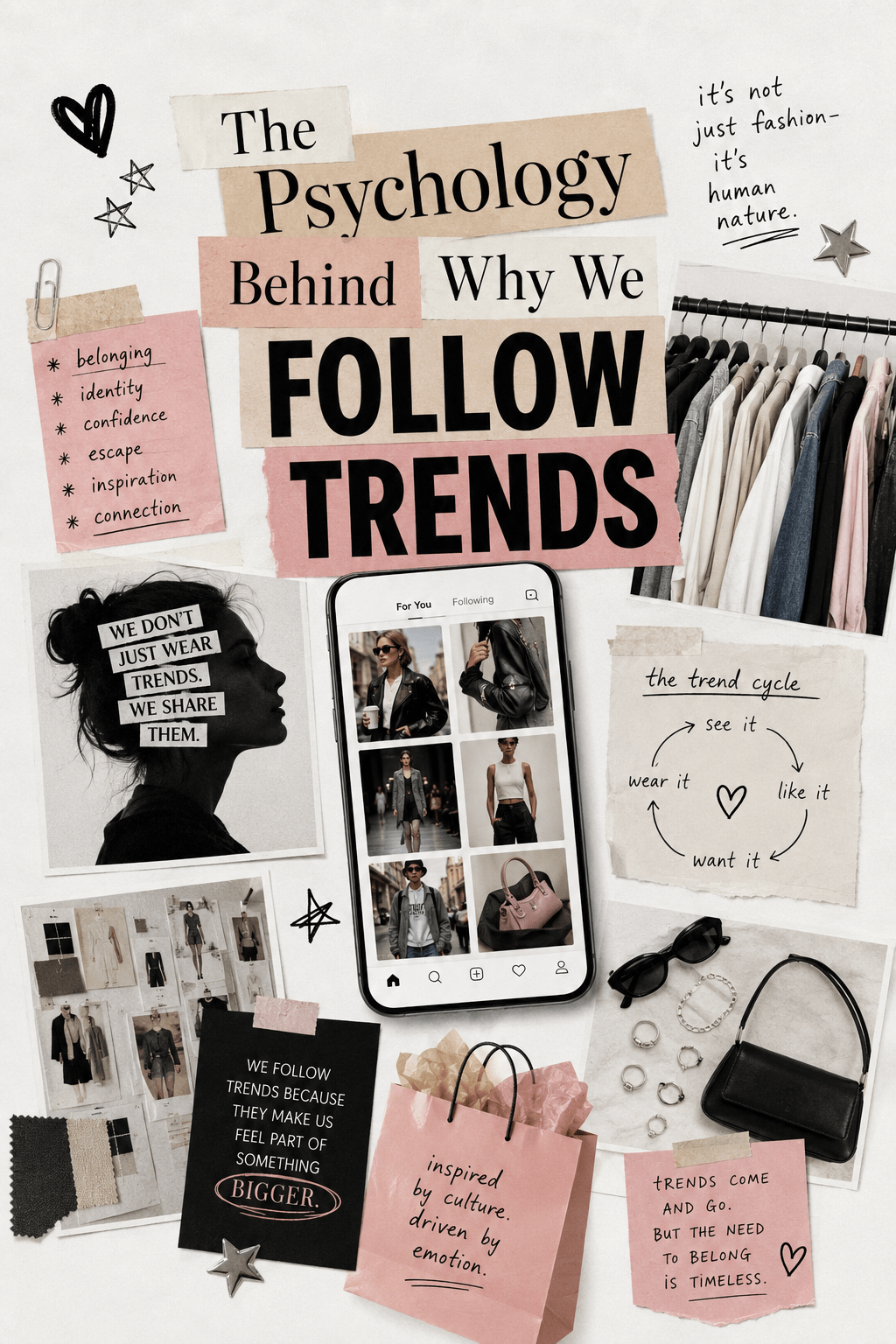
Fashion trends often seem to appear overnight.
One week, everyone is wearing slim sneakers. The next, oversized handbags have replaced micro purses, lace is everywhere, and suddenly capri pants have returned after years of being considered outdated. It’s easy to assume trends begin on the runway or on social media, but their influence runs much deeper than a new collection or a viral video.
At their core, fashion trends are driven by human psychology.
The clothes we choose rarely communicate only personal taste. They also reflect identity, belonging, aspiration, and the subtle ways people connect with one another. Fashion has always been one of the most visible forms of self-expression, but it’s equally a form of social communication.
Every outfit tells a story.
Psychologists have long understood that people naturally look to others when making decisions, particularly in situations where there isn’t a clear right or wrong answer. Fashion is one of those spaces. Without realizing it, we observe what people around us are wearing, what appears in magazines, what fills our social media feeds, and what our favorite designers, musicians, or actors choose to wear.
Over time, familiarity becomes acceptance.
A silhouette that once felt unusual begins to feel normal. A shoe we initially disliked suddenly seems appealing after seeing it repeatedly styled in different ways. This phenomenon, often referred to as the “mere exposure effect,” helps explain why many of fashion’s most controversial trends eventually become mainstream.
The more we see something, the more comfortable we become with it.
But following trends isn’t simply about fitting in.
It’s also about participating in a cultural conversation.
Fashion has always reflected the values and priorities of the moment. During periods of economic uncertainty, wardrobes often become more practical. Times of optimism tend to encourage bolder colors and experimentation. Minimalism, maximalism, quiet luxury, and streetwear all tell us something about the era in which they flourish.
The clothing changes because society changes.
Social media has accelerated that process dramatically.
Where trends once unfolded over months or even years through magazines and runway shows, today’s fashion landscape moves at an unprecedented pace. A single post can introduce a new styling idea to millions of people within hours. Algorithms reinforce what captures attention, creating the impression that certain pieces are suddenly everywhere.
In many ways, trends spread today much like ideas themselves.
Yet despite the speed of modern fashion, people rarely adopt every trend they encounter.
Instead, they choose the ones that align with how they already see themselves—or how they hope to be seen.
Someone drawn to minimalism may embrace tailored trousers and leather loafers while ignoring brighter, more expressive trends. Others might gravitate toward oversized streetwear, romantic lace, or vintage-inspired silhouettes because those styles feel authentic to their identity.
Fashion isn’t simply about copying.
It’s about editing.
This balance between individuality and belonging is one of the industry’s greatest contradictions. Most people want to feel unique, but very few want to feel completely disconnected from the culture around them. Trends offer a middle ground. They provide a shared visual language while leaving room for personal interpretation.
That’s why no two people wear the same trend in exactly the same way.
The most stylish wardrobes often belong to people who understand this instinctively. Rather than chasing every new release, they selectively incorporate trends that complement their existing style. A single oversized handbag, a pair of ballet sneakers, or a leather bomber jacket can refresh an entire wardrobe without replacing it.
Personal style evolves.
It doesn’t reset every season.
Perhaps that’s why the conversation around trends has shifted in recent years. More consumers are questioning fast-moving fashion cycles and focusing instead on longevity, versatility, and thoughtful purchasing. The goal is no longer to own everything that’s popular, but to understand which pieces genuinely deserve a place in a wardrobe.
Following a trend has become less about imitation and more about intention.
Fashion, after all, has never been just about clothing.
It’s about identity.
About community.
About culture.
And about the quiet, everyday choices that allow us to communicate who we are before we’ve spoken a single word.
FINAL NOTE:
Fashion trends may begin with designers or social media, but they endure because of people. Every trend reflects a deeper human desire—to belong, to express ourselves, or simply to participate in a shared cultural moment. Understanding why we follow trends may be just as fascinating as the trends themselves.
 Archive Editorial
Leave a comment